|
Black Figures On
White Silence (piano solo and dance)
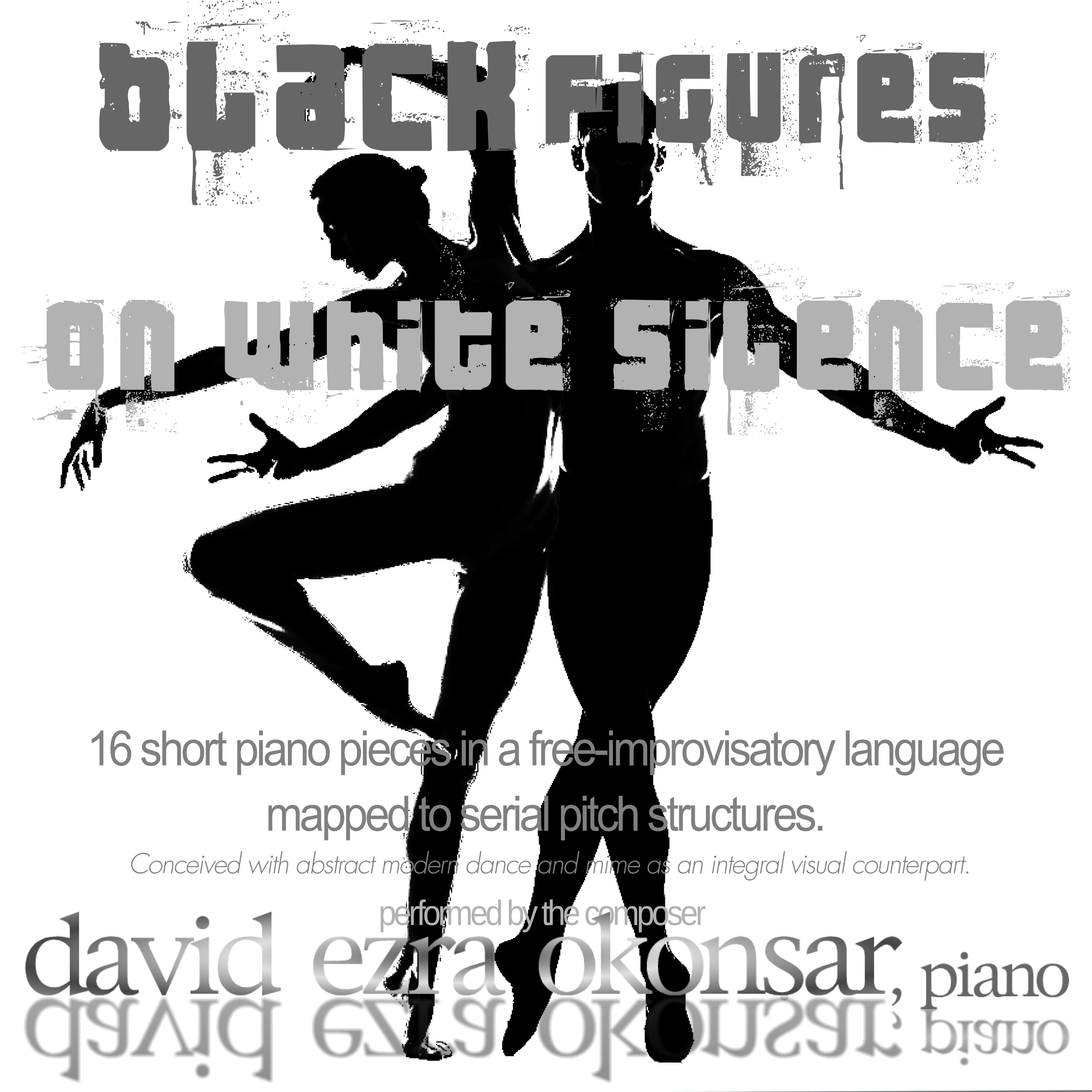
16 short piano pieces in a free-improvisatory language mapped to serial pitch structures. Conceived with abstract modern dance and mime as an integral visual counterpart. This collection presents a cycle of short solo-piano pieces rooted in twelve-tone (serial) technique, yet guided by a distinctly melodic, lyrical, and inspirational impulse. Rather than treating serialism as an austere system, these works approach the twelve-tone row as a field of expressive possibility—a source from which gesture, contour, and resonance can emerge with clarity and emotional immediacy. Each piece unfolds in compact form, generally under three minutes, favoring concentration over expansion. The music speaks in brief statements, pauses, and returns—akin to choreographic phrases—where every sound carries weight. This concision allows the listener to perceive form not as large architecture, but as living motion, moment by moment, breath by breath. Silence, decay, and resonance are integral; what is left unsaid shapes the meaning of what is heard. Although rigorously derived from twelve-tone series, the music avoids mechanical sequencing. Rows are bent, fractured, mirrored, and re-ordered intuitively, often responding to the tactile reality of the keyboard. The piano is treated not merely as a pitch instrument, but as a physical space—registers acting like vertical planes, intervals like distances crossed by the hand, and dynamics like shifts in bodily weight. In this sense, the music remains inherently corporeal, inviting movement even when none is seen. A central influence is dance, particularly contemporary and modern ballet aesthetics. Musical ideas function as gestures: a sudden lift, a suspended balance, a controlled collapse, a sharp turn followed by stillness. Rhythmic flow often mirrors the logic of movement rather than meter, allowing phrases to stretch, recoil, or pivot unexpectedly. These pieces are conceived as potential companions to dance—yet never subordinate to it—maintaining their autonomy as musical statements. Texturally, many passages draw on free-jazz–like improvisational energy. Figures arise spontaneously, layered or abandoned mid-thought, as if discovered in the act of playing. This sense of immediacy is essential: the music feels captured on the fly, alive with risk and responsiveness. Beneath this apparent freedom, however, lies a precise serial mapping—improvisational gestures anchored to and filtered through the twelve-tone material, ensuring coherence without constraint. The result is a sound world that balances discipline and freedom, structure and intuition. Serial technique provides the skeleton; improvisation supplies breath and motion. The listener may not consciously trace the row, yet can feel its presence as a gravitational force shaping the musical terrain. While conceived with piano and dance in mind, these works are equally compelling as purely auditory experiences. Heard without visual accompaniment, they invite a different kind of listening: one attuned to inner movement, imagined space, and emotional nuance. The absence of explicit narrative leaves room for personal interpretation—each listener may sense their own choreography unfolding within the sound. Ultimately, this project proposes a reconciliation: that serial music can be sensuous, that rigor can coexist with lyricism, and that contemporary piano writing can remain both intellectually engaged and immediately human. These brief pieces offer distilled moments of intensity—fleeting, focused, and resonant—where modern technique serves not abstraction, but expression. FR Ce cycle réunit de courtes pièces pour piano solo ancrées dans la technique dodécaphonique (sérielle), mais animées par un élan résolument mélodique, lyrique et inspirant. Loin d’un système austère, la série de douze sons y est abordée comme un champ de possibilités expressives : une source d’où émergent geste, contour et résonance avec clarté et immédiateté émotionnelle. Chaque pièce adopte une forme concentrée, généralement inférieure à trois minutes, privilégiant l’intensité à l’expansion. La musique avance par énoncés brefs, suspensions et retours, à la manière de phrases chorégraphiques, où chaque son compte. Le silence, la résonance et l’extinction du timbre participent pleinement du discours ; ce qui n’est pas joué façonne autant le sens que ce qui est entendu. Bien que rigoureusement issues de séries dodécaphoniques, ces œuvres évitent toute mécanique systématique. Les rangées sont fracturées, réfléchies, réordonnées intuitivement, souvent en réponse directe au contact physique avec le clavier. Le piano est envisagé comme un espace corporel : les registres deviennent des plans verticaux, les intervalles des distances à franchir, les dynamiques des déplacements de poids. Ainsi, la musique demeure profondément incarnée, appelant le mouvement même en l’absence de danse visible. La danse — en particulier les esthétiques contemporaines et du ballet moderne — constitue une référence centrale. Les idées musicales fonctionnent comme des gestes : un élan soudain, un équilibre suspendu, une chute maîtrisée, un pivot net suivi d’immobilité. Le flux rythmique épouse souvent la logique du mouvement plutôt que celle de la mesure, autorisant des phrases qui s’étirent, se replient ou bifurquent de façon imprévisible. Ces pièces sont pensées comme des partenaires possibles de la danse, sans jamais s’y subordonner, conservant leur autonomie musicale. Sur le plan des textures, de nombreux passages s’inspirent d’une énergie improvisée proche du free jazz. Des figures surgissent, se superposent, s’interrompent à mi-parcours, comme découvertes dans l’instant même du jeu. Cette sensation d’immédiateté — captée sur le vif — est essentielle : le risque, l’écoute et la réactivité sont palpables. Sous cette liberté apparente demeure toutefois une cartographie sérielle précise ; les gestes improvisés sont ancrés et filtrés par la série de douze sons, assurant une cohérence sans contrainte. Il en résulte un univers sonore où discipline et liberté, structure et intuition coexistent. La technique sérielle fournit l’ossature ; l’improvisation, le souffle et le mouvement. L’auditeur n’a pas besoin d’identifier consciemment la série pour en percevoir la force gravitationnelle, qui organise le paysage musical. Conçues pour le piano et la danse, ces œuvres se prêtent tout autant à une écoute purement sonore. Sans support visuel, elles invitent à une écoute intérieure, attentive aux mouvements imaginés, aux espaces suggérés et aux nuances émotionnelles. L’absence de narration explicite ouvre un vaste champ d’interprétations : chacun peut y projeter sa propre chorégraphie intime. Ce projet propose ainsi une réconciliation : la musique sérielle peut être sensuelle, la rigueur peut cohabiter avec le lyrisme, et l’écriture pianistique contemporaine demeurer à la fois exigeante et profondément humaine. Ces pièces brèves offrent des instants d’intensité distillés — fugaces, concentrés, résonants — où la modernité technique est au service de l’expression. TR Bu çalışma, solo piyano için kısa parçalardan oluşan bir döngüdür ve temelini on iki ton (seri) tekniği oluşturur. Ancak bu müzik, katı ve soyut bir sistem anlayışından bilinçli olarak uzak durur; seri, burada melodik, lirik ve ilham verici bir ifade alanı olarak ele alınır. On iki ses dizisi, bir kural yığını değil, jestlerin, hatların ve rezonansın özgürce filizlenebileceği canlı bir zemin hâline gelir. Her parça yoğunlaştırılmış bir form içinde, genellikle üç dakikanın altında şekillenir. Geniş anlatılar yerine, kısa müzikal cümleler, duraksamalar ve geri dönüşler ön plandadır. Bu yaklaşım, müziği mimari bir yapıdan çok anlık bir hareket olarak algılamayı sağlar. Sessizlik, yankı ve sesin sönüşü müziğin ayrılmaz bir parçasıdır; çalınmayan alanlar, çalınan sesler kadar anlam taşır. Eserler titizlikle seri teknikten türetilmiş olsa da, mekanik bir dizilimden özellikle kaçınılır. Diziler parçalanır, yansıtılır, yeniden sıralanır ve çoğu zaman piyanoyla fiziksel temasın sezgisel tepkileriyle biçimlenir. Piyano burada yalnızca bir perde aracı değil, bedensel bir mekân olarak düşünülür: register’lar düşey alanlar, aralıklar kat edilen mesafeler, dinamikler ise ağırlık ve denge değişimleri gibidir. Bu nedenle müzik, özü itibarıyla bedensel ve hareket çağrışımlıdır. Dans, özellikle çağdaş ve modern bale estetikleri, bu müziğin düşünsel merkezlerinden biridir. Müzikal fikirler birer jest gibi davranır: ani bir yükseliş, askıda kalan bir denge, kontrollü bir düşüş, ardından gelen keskin bir dönüş ve duruş. Ritmik akış çoğu zaman ölçüsel düzen yerine hareket mantığını izler; cümleler esner, içe kapanır ya da beklenmedik yönlere sapar. Bu parçalar dans için tasarlanmış bir eşlik olasılığı taşır, ancak hiçbir zaman dansa bağımlı değildir; bağımsız müzikal varlıklarını korurlar. Dokusal düzlemde, pek çok bölüm free jazz benzeri doğaçlamacı bir enerji taşır. Figürler aniden ortaya çıkar, üst üste biner ya da yarım bırakılır; sanki icra anında keşfediliyormuş hissi verir. Bu “anında yakalanmış” olma duygusu esastır: risk, sezgi ve anlık kararlar müziğin yüzeyinde hissedilir. Bununla birlikte, bu özgürlük titiz bir seri haritalama ile dengelenir; doğaçlamaya benzeyen jestler, on iki ton dizisi tarafından sabitlenir ve yönlendirilir. Ortaya çıkan ses dünyası, disiplin ile özgürlüğün, yapı ile sezginin dengeli bir birlikteliğidir. Seri teknik iskeleti kurar; nefes, akış ve hareket ise sezgisel icradan doğar. Dinleyici diziyi bilinçli olarak takip etmese bile, onun çekim gücünü ve biçimlendirici etkisini sezgisel olarak algılar. Müzik her ne kadar piyano ve dans düşüncesiyle tasarlanmış olsa da, yalnızca işitsel bir deneyim olarak da bütünüyle değerlidir. Görsel unsur olmadan dinlendiğinde, içsel hareketleri, hayali mekânları ve duygusal geçişleri tetikler. Açık bir anlatının yokluğu, dinleyiciye kendi iç koreografisini kurma özgürlüğü tanır. Bu proje, bir uzlaşma önerir: seri müzik duyusal olabilir, katılık lirizmle bir arada var olabilir ve çağdaş piyano yazımı hem entelektüel olarak titiz, hem de doğrudan insani kalabilir. Bu kısa parçalar, yoğunlaştırılmış anlar sunar — geçici, odaklanmış ve yankılı — modern tekniğin ifadenin hizmetinde olduğu anlar. |
||||||||||||||||||||||||||
| |
||||||||||||||||||||||||||
|
||||||||||||||||||||||||||